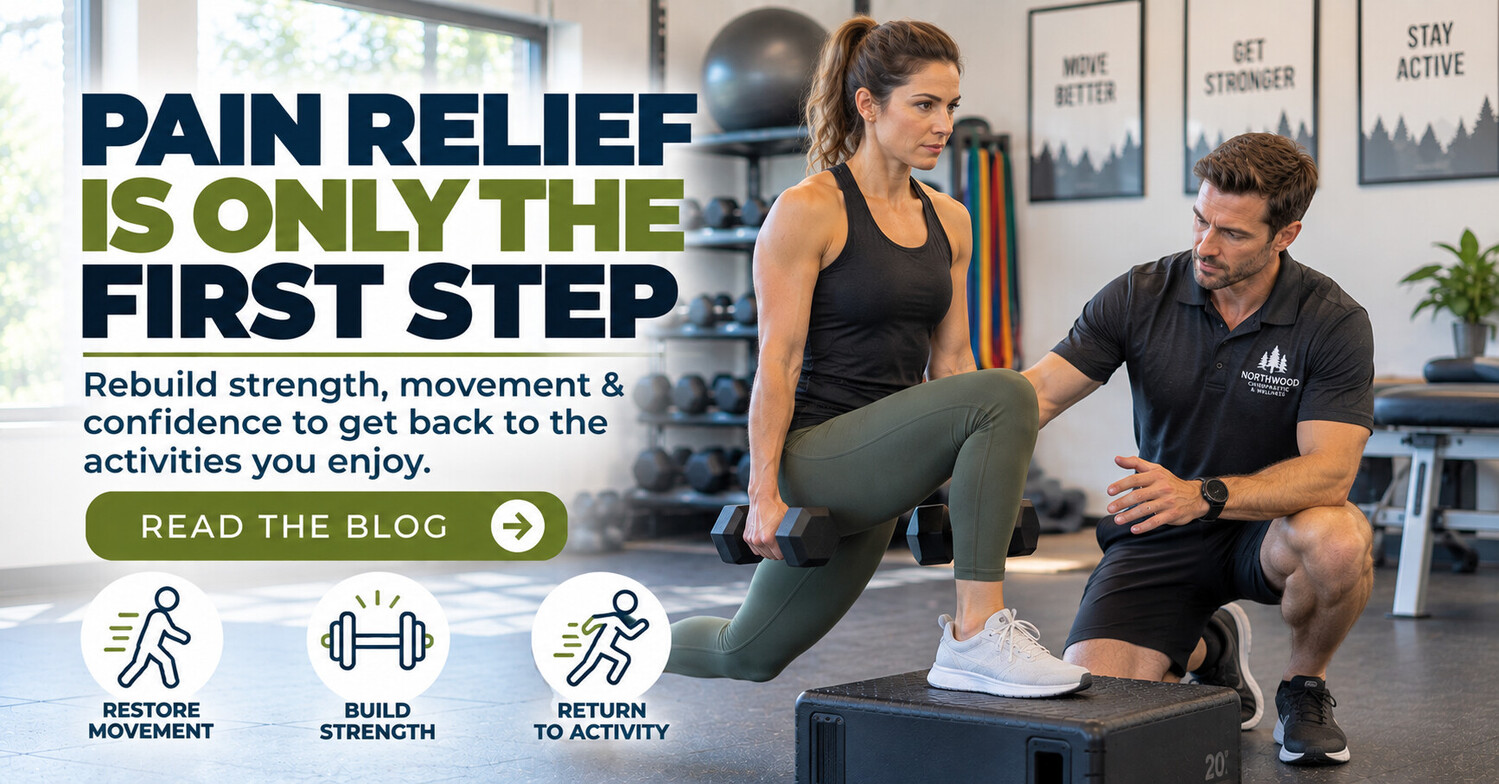
When you're recovering from an injury, getting out of pain is usually only the first step.
The bigger goal is getting back to what you need and want to do—whether that's working, exercising, playing a sport, taking care of your family, or simply moving comfortably throughout the day.
That's where rehabilitation and movement can play an important role.
Rather than focusing only on where something hurts, rehabilitation helps rebuild the strength, mobility, coordination, and physical capacity you need to return to activity.
Pain Relief Isn't the Same as Recovery
It's possible for pain to improve before your body is completely prepared to return to normal activity.
For example, after an injury you may temporarily lose:
- Strength
- Range of motion
- Balance
- Coordination
- Confidence in a movement
- Tolerance to physical activity
If you immediately return to your previous workload simply because the pain has decreased, you may be asking your body to do more than it's currently prepared to handle.
Rehabilitation helps bridge that gap.
What Does Rehabilitation Actually Do?
Rehabilitation should be specific to both your problem and your goals.
Someone trying to return to running needs something different than someone trying to comfortably sit through a workday.
Likewise, a golfer may have different demands than someone recovering from a low-back injury who needs to lift at work.
A rehabilitation program may include:
- Mobility exercises
- Strengthening
- Balance training
- Coordination exercises
- Progressive loading
- Sport- or work-specific movements
- Education about activity modification
- Gradual return to normal activity
The exercises should progress as your ability improves.
Start With What You Can Do
A common mistake after an injury is thinking exercise needs to be completely pain-free before you begin.
That's not always necessary.
Depending on the injury, some movement may be appropriate even while symptoms are still present.
The key is finding a level of activity your body currently tolerates.
From there, we can gradually increase the challenge.
For example:
Walking → longer walking → strengthening → more demanding activity → return to sport or work.
Recovery is often a progression rather than an on/off switch.
Strength Matters
Strength is one of the body's most important tools for handling physical stress.
If you've been injured or inactive, your capacity may decrease.
Progressive strengthening helps rebuild your ability to tolerate everyday demands.
Depending on the problem, exercises might target:
- Core and trunk
- Hips
- Legs
- Shoulders
- Upper back
- Specific movements required for work or sports
The objective isn't simply to make a muscle stronger.
It's to help your body become better prepared for the activities you need it to perform.
What About Mobility?
Mobility can also be important—but more flexibility isn't automatically better.
You need enough movement to perform the activities that matter to you.
If limited motion is interfering with your ability to move comfortably, targeted mobility exercises may be useful.
But rehabilitation shouldn't become an endless attempt to make every joint as flexible as possible.
Useful mobility is goal-specific.
Where Does Chiropractic Care Fit?
For some musculoskeletal injuries, chiropractic care can be used alongside rehabilitation.
Manual treatment may help reduce symptoms or improve comfortable movement while exercise helps rebuild physical capacity.
For example, someone with back pain may initially benefit from treatment that helps them move more comfortably.
As symptoms improve, strengthening and progressively returning to activity become increasingly important.
The two approaches don't need to compete.
They can serve different purposes within the same treatment plan.
What About Massage Therapy?
Massage therapy may also be useful for managing muscle soreness, tension, or stiffness during recovery.
Some patients find that massage helps them move or exercise more comfortably.
Like chiropractic treatment, however, massage doesn't replace the need to rebuild strength and capacity when those qualities have been lost.
How Quickly Should Rehabilitation Progress?
There's no universal timeline.
Recovery depends on factors such as:
- Type of injury
- Severity
- How long symptoms have been present
- Current strength and mobility
- Previous activity level
- Work or sport demands
- Overall health
- Response to treatment
Progress should be based on how you're actually responding, not simply how many days have passed.
How Do You Know Rehabilitation Is Working?
Pain is one measure—but it shouldn't be the only one.
We may also look at whether you're improving your:
- Range of motion
- Strength
- Walking tolerance
- Sitting or standing tolerance
- Ability to lift
- Ability to exercise
- Work capacity
- Sports performance
- Confidence in movement
Those functional improvements often tell us more about recovery than a pain number alone.
What If You're Not Improving?
Treatment shouldn't continue indefinitely without progress.
If symptoms aren't improving as expected, we may need to reconsider the diagnosis or treatment plan.
Depending on your symptoms, that could mean:
- Modifying your rehabilitation program
- Additional examination
- Imaging
- Referral to another healthcare provider
- A different treatment approach
Knowing when something isn't responding appropriately is an important part of good rehabilitation.
Rehabilitation & Movement in Maple Grove, MN
At Northwood Chiropractic & Wellness, rehabilitation isn't about handing every patient the same sheet of stretches.
We want to understand what you need to get back to doing.
Then we can progressively work toward that goal.
Depending on your condition, your treatment plan may combine rehabilitation and movement, chiropractic care, massage therapy, or other conservative approaches.
The goal isn't simply to get you out of pain.
It's to help you get back to your life.
Start Feeling Better for Just $19
Your first visit includes a consultation, comprehensive exam, X-rays if needed, and your first chiropractic adjustment when clinically appropriate.

Dr. Greg Beenken
Contact Me