Low back pain is extremely common.
It can show up suddenly after lifting something, gradually after weeks of increased activity, or seemingly for no obvious reason at all.
For some people it's a dull ache. For others it's sharp pain that makes bending, sitting, standing, or getting out of bed difficult.
And sometimes back pain travels into the buttock or leg.
The important thing to understand is that low back pain isn't one specific condition.
Finding the right approach starts with understanding what's happening.
What Causes Low Back Pain?
There are many potential contributors to low back pain.
Common possibilities include:
- Muscle or ligament irritation
- Joint-related pain
- Disc irritation
- Disc herniation
- Arthritis and age-related changes
- Increased physical workload
- Sudden changes in exercise
- Prolonged inactivity
- Previous injuries
Sometimes a specific structure can be identified.
Other times, particularly with uncomplicated low back pain, there may not be one single structure responsible for the symptoms.
That doesn't mean the pain isn't real.
Does Back Pain Mean Something Is Damaged?
Not necessarily.
Pain is an important protective response, but the amount of pain you're experiencing doesn't always correspond directly with the amount of tissue damage.
Someone can experience severe back pain without a serious structural injury.
Likewise, imaging frequently identifies changes such as:
- Disc degeneration
- Disc bulges
- Arthritis
- Bone spurs
in people who have little or no back pain.
Imaging findings need to be interpreted alongside your symptoms and physical examination.
What About a Herniated or Bulging Disc?
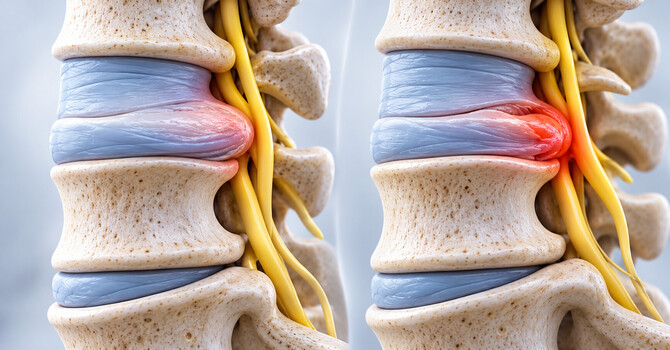
Discs sit between the vertebrae and help distribute forces through the spine.
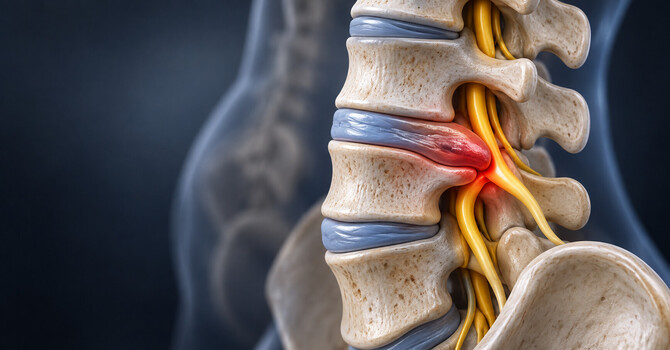
Disc bulges and herniations can sometimes contribute to back pain.
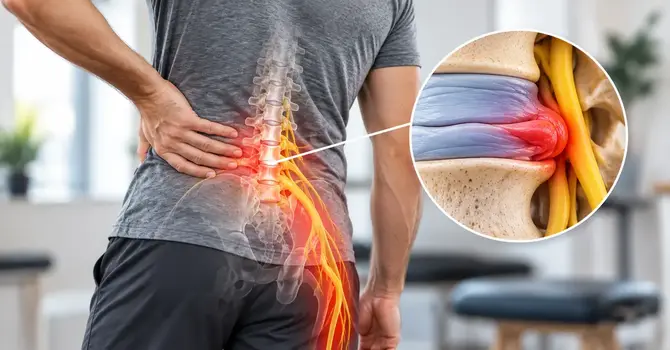
If disc material irritates or compresses a nerve, symptoms may extend into the leg.
That can produce:
- Leg pain
- Numbness
- Tingling
- Weakness
When symptoms travel along the sciatic nerve distribution, they're commonly referred to as sciatica.
But finding a disc bulge on an MRI doesn't automatically mean it's the source of your pain.
Disc changes are also found in people without symptoms.
Should You Rest When Your Back Hurts?
A short period of modifying painful activities may be reasonable when your back is particularly irritated.
But prolonged bed rest generally isn't the goal.
For many episodes of uncomplicated low back pain, continuing comfortable movement and gradually returning to normal activity is preferable to avoiding movement altogether.
That could begin with something as simple as walking.
As symptoms improve, you can progressively return to more demanding activity.
Is Bending Bad for Your Back?
Your spine is designed to move.
Bending isn't inherently dangerous.
The ability to bend, lift, twist and carry is part of normal life.
If a particular movement is currently painful, it may make sense to temporarily modify it.
But the long-term goal generally isn't to avoid that movement forever.
Through rehabilitation and movement, you can progressively rebuild your ability to tolerate the movements required for work, exercise and everyday life.
Strength Training Can Be Part of the Solution
People with back pain are sometimes afraid that lifting weights will make their condition worse.
But appropriate strengthening can be an important part of improving your physical capacity.
Depending on your starting point, rehabilitation might include:
- Walking
- Squats
- Hip-hinge movements
- Rows
- Carries
- Trunk exercises
- Progressive resistance training
There isn't one magical “core exercise” that fixes every back problem.
The goal is to gradually make your body more capable.
Can Chiropractic Care Help Low Back Pain?
For some types of musculoskeletal low back pain, chiropractic care may be a reasonable conservative treatment option.
Spinal manipulation and other manual treatments can help some patients reduce symptoms and move more comfortably.
But an adjustment isn't literally putting a vertebra that has slipped “back into place.”
And treatment shouldn't consist only of repeatedly adjusting the same area indefinitely.
As symptoms improve, exercise, movement and gradually returning to normal activities may become increasingly important.
When Might Spinal Decompression Be Considered?
Some patients with disc-related symptoms or radiating leg pain may be candidates for spinal decompression.
Mechanical decompression uses controlled traction to temporarily change forces through the spine.
It isn't appropriate for every type of back pain, and it shouldn't be presented as physically pulling a herniated disc back into place.
Whether it's reasonable depends on your history, examination and diagnosis.
Can Massage Help?
Massage therapy may help manage muscle soreness, stiffness or tension that accompanies low back pain.
For some people, reducing muscle discomfort can make it easier to move and exercise.
Like other passive treatments, however, massage is generally best viewed as one potential tool rather than something that permanently fixes the underlying problem.
When Does Back Pain Need Medical Attention?
Most back pain isn't caused by a medical emergency.
However, certain symptoms deserve prompt evaluation.
Seek medical attention if back pain is associated with:
- New loss of bowel or bladder control
- Numbness around the groin or saddle region
- Significant or progressive leg weakness
- Fever or systemic illness
- Major trauma
- Unexplained weight loss
- Severe pain associated with significant neurological changes
These symptoms can indicate a condition requiring additional medical evaluation.
What If Your Back Pain Keeps Coming Back?
Recurring back pain doesn't necessarily mean your spine is deteriorating.
Instead, look at the pattern.
Ask:
What activities tend to trigger it?
Has your workload changed?
Has your activity level decreased?
Are you strong enough for the demands you're placing on your body?
Are you recovering adequately?
Sometimes the long-term solution involves improving what your body is capable of doing rather than continually trying to avoid whatever caused discomfort.
Low Back Pain Treatment in Maple Grove, MN
At Northwood Chiropractic & Wellness, we start by determining what appears to be contributing to your back pain and whether conservative care is appropriate.
Depending on your condition, treatment may include chiropractic care, rehabilitation and movement, massage therapy, spinal decompression, activity modification, or referral for additional evaluation when necessary.
The goal isn't to convince you that your back is fragile or permanently “out of alignment.”
It's to help you move comfortably, rebuild your capacity and get back to doing the things that matter to you.
Start Feeling Better for Just $19
Your first visit includes a consultation, comprehensive exam, X-rays if needed, and your first chiropractic adjustment when clinically appropriate.

Dr. Greg Beenken
Contact Me