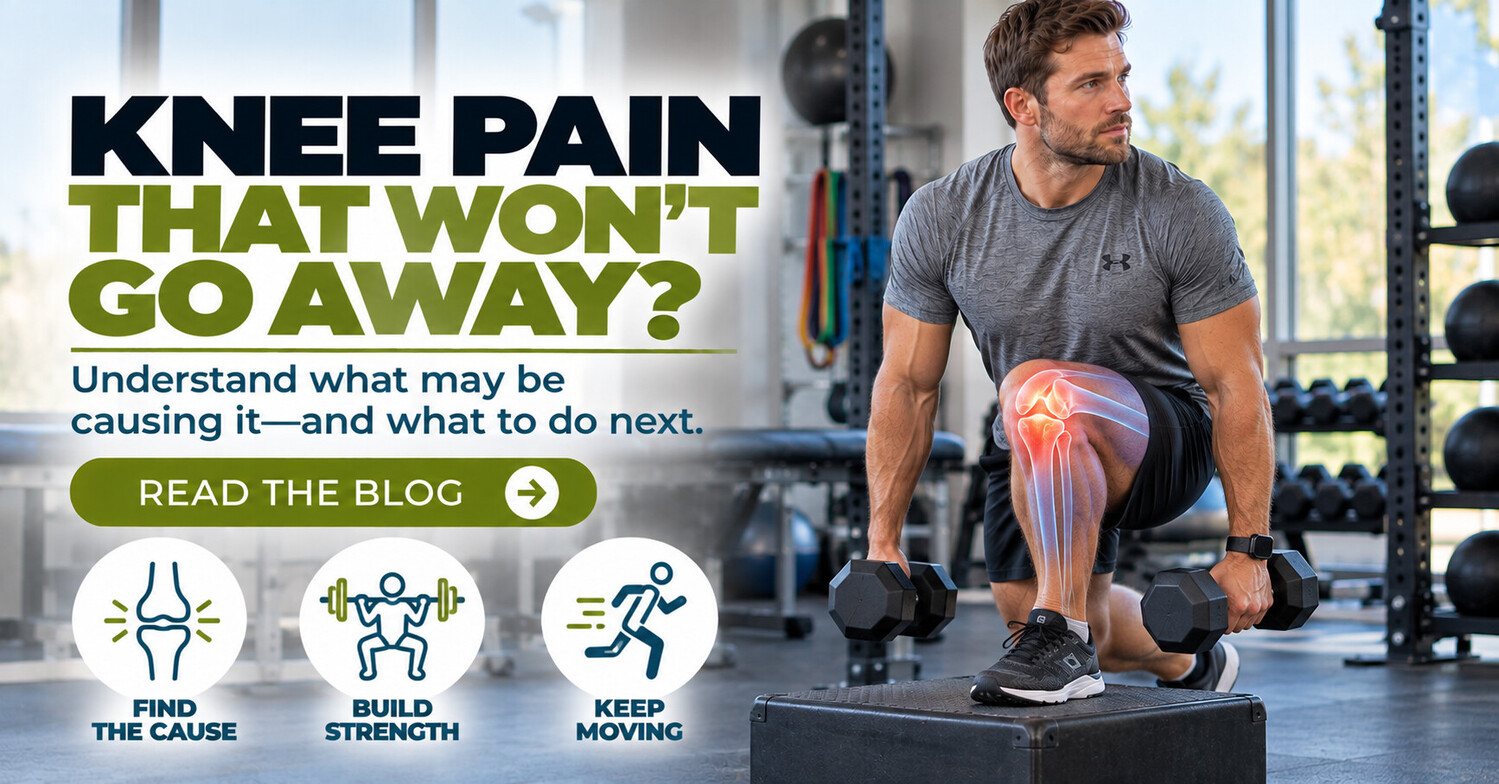
Knee pain can make everyday activities surprisingly difficult.
Walking downstairs, squatting, running, getting out of a chair or even sitting for long periods can become uncomfortable.
Sometimes knee pain improves quickly. Other times, it sticks around or keeps returning every time you become active.
So what should you do when your knee pain won't go away?
What Causes Knee Pain?
There isn't one single cause of knee pain.
Common possibilities include:
- Patellofemoral pain
- Tendon irritation
- Meniscus injuries
- Ligament injuries
- Osteoarthritis
- Muscle strains
- Increased training or activity
- A direct injury or fall
- Pain referred from the hip or lower back
Determining what's most likely causing your symptoms is more useful than simply assuming your knee is “out of alignment.”
What Is Patellofemoral Pain?
Patellofemoral pain is one of the most common causes of pain around or behind the kneecap.
It's sometimes called runner's knee, although you certainly don't have to be a runner to experience it.
Symptoms may become noticeable during activities such as:
- Running
- Squatting
- Climbing stairs
- Hiking
- Jumping
- Getting up from a chair
- Sitting with the knees bent for extended periods
The problem often involves a mismatch between the activity you're asking your knee to tolerate and its current capacity.
That doesn't necessarily mean something is damaged or incorrectly aligned.
Does Knee Popping Mean Something Is Wrong?
Not necessarily.
Knees commonly pop, crack and make other noises during movement.
Joint noises without pain, swelling, locking or loss of function usually aren't a reason for concern.
It's more important to pay attention when clicking or popping occurs along with:
- Pain
- Significant swelling
- Locking or catching
- Giving way
- Loss of motion
Those symptoms may warrant an evaluation.
Should You Rest a Painful Knee?
Sometimes temporarily reducing an aggravating activity makes sense.
But complete rest isn't usually the long-term solution for routine knee pain.
For example, if running five miles aggravates your knee, you may temporarily reduce your mileage rather than stop all physical activity.
The goal is often to find an amount of activity your knee tolerates and gradually build from there.
Strength Training Can Be an Important Part of Recovery
One of the most useful tools for many types of knee pain is progressive exercise.
Depending on the problem, rehabilitation and movement may include exercises targeting the:
- Quadriceps
- Hamstrings
- Glutes
- Calves
- Hips
The goal isn't simply to make your knee “looser.”
It's to improve the strength and capacity needed for the things you want to do.
What About Knee Arthritis?
Finding arthritis on an X-ray doesn't automatically mean you need to stop exercising.
Osteoarthritis becomes increasingly common with age, and the severity of changes seen on imaging doesn't always correspond directly with how much pain someone experiences.
Appropriate exercise and strengthening are often important parts of managing knee osteoarthritis.
If you've been told your knee is “bone-on-bone,” that doesn't automatically mean movement is dangerous.
Can Chiropractic Care Help Knee Pain?
That depends on what's causing it.
A knee complaint should first be evaluated to determine whether conservative treatment is appropriate.
For certain musculoskeletal knee problems, chiropractic care may be combined with exercise and rehabilitation to address mobility, strength and activity tolerance.
The emphasis shouldn't be on repeatedly “putting the knee back into alignment.”
The goal is to help you move comfortably and progressively return to your normal activities.
Could Knee Pain Actually Come From Somewhere Else?
Sometimes.
Problems involving the hip or lower back can occasionally produce symptoms that are felt around the knee.
That's one reason an examination may include more than just the painful joint.
If knee symptoms occur alongside back pain, numbness, tingling or weakness, evaluating the spine and nervous system may also be appropriate.
When Should Knee Pain Be Evaluated?
Consider having your knee evaluated if:
- Pain persists or continues returning
- Your knee becomes significantly swollen
- You can't comfortably bear weight
- The knee repeatedly gives way
- You experience locking or significant catching
- You can't fully bend or straighten the knee
- Symptoms started after significant trauma
- Pain is progressively worsening
A visibly deformed knee, inability to bear weight after significant trauma, a hot and markedly swollen joint, or knee symptoms accompanied by fever warrants prompt medical evaluation.
Knee Pain Treatment in Maple Grove, MN
At Northwood Chiropractic & Wellness, we evaluate musculoskeletal problems to determine what's likely contributing to your symptoms and whether conservative care is appropriate.
Depending on your condition, treatment may include rehabilitation and movement, chiropractic care, massage therapy or referral for additional evaluation when necessary.
The goal is simple:
Help you get back to walking, exercising, working and doing the activities you enjoy.
Start Feeling Better for Just $19
Your first visit includes a consultation, comprehensive exam, X-rays if needed, and your first chiropractic adjustment when clinically appropriate.

Dr. Greg Beenken
Contact Me